


As you probably already know, hormonal balance plays a crucial role in the well-being of menstruating people. Hormonal fluctuations can occur not only during menopause. Stress, an unhealthy lifestyle, or hormonal contraception can also lead to discomfort such as cycle fluctuations, PMS, or period pain. The good news: there are natural ways to support hormonal balance – and medicinal plants are a valuable help! In this article, we introduce you to 5 medicinal plants that can naturally support women in regulating their hormonal system and which form the basis of our products.
Contents:
Conclusion - Our recommendation
Which medicinal plants support natural hormonal balance?
In traditional phytotherapy, there are a variety of herbs for hormonal balance, i.e., women's herbs, that support the natural hormonal balance and balance the cycle. We would like to introduce you to 5 plants that we trust so much thanks to an excellent body of research that they made their way into our products.
Chasteberry (Vitex agnus-castus)
Chasteberry is a shrub that bears pepper-like fruits. The extract from these fruits is one of the most commonly used plant-based active ingredients for cycle discomfort and for regulating the female hormonal balance. If you go to your gynecologist with hormonal discomfort, you will very likely leave the practice with either a prescription for the contraceptive pill or a pack of agnus-castus. This is because chasteberry shows very good effects for a variety of cycle discomforts, which are also supported by many studies. Cycle fluctuations and PMS, including water retention, swollen breasts, painful breasts, mood swings, irritability, anger, or headaches can be very well alleviated by the effect of agnus-castus on the estrogen-progesterone balance [1, 2, 3].

Watercress (Nasturtium officinale)
Watercress should actually be on our menu. Because the plant that grows near water is, like many wild herbs, super rich in vitamin C, iron, calcium, and antioxidants. In addition, it belongs to the cruciferous plants and has an unusual, peppery taste due to its high content of isothiocyanates. As a medicinal plant for the female hormonal balance and natural hormone balance, it is indispensable, as like all cruciferous plants, it contains indole-3-carbinol and sulforaphane, which have positive effects on estrogen metabolism and women's health. Read detailed information about cruciferous plants and studies here. Watercress had particularly high antioxidant and liver-protective effects in studies [4,5].

Red clover (Trifolium pratense)
You have surely seen red clover many times before, and perhaps even picked its pretty red flowers for a bouquet or braided them into a hair wreath - after all, red clover can be found in almost every green space. Red clover is also used just as frequently in women's medicine, especially for menopausal symptoms. Responsible for the positive effect on the estrogen and progesterone balance [6] and also on glucose metabolism [7] is the high content of isoflavones.

Yam (Dioscorea villosa)
Although yam is not one of the herbs, it deserves a mention in this article as a medicinal plant for the female hormonal system. The tuber of the yam plant is used as food in many African countries, among others, but here it is known more as a dietary supplement or active ingredient in women's medicine, e.g., in natural progesterone creams. The reason for this is its high content of diosgenin. Diosgenin is a progesterone-like substance, which is used primarily for the synthesis of steroid hormones for contraception. Studies have been able to show that the consumption of yam can increase blood levels of progesterone, estrogen precursors, and sex hormone-binding globulin (SHBG), and lower free testosterone [8, 9, 10, 11]. In addition, the ingredients of yam are antioxidant and anti-inflammatory.

Chinese angelica (Angelica sinensis)
Chinese angelica has many names, among others it is called “female ginseng”. In Traditional Chinese Medicine (TCM), it is known as Dong Quai. But its area of use is clear - women's medicine. Chinese angelica is used to alleviate menopausal symptoms, hot flashes, mood swings, as well as menstrual disorders and missed periods. In addition, Chinese angelica promotes blood circulation in the pelvic organs and thus has a cramp-relieving effect on menstrual pain [12, 13].

Why natural medicinal plants are so important for hormone regulation
Natural medicinal plants offer a gentle and effective way to support hormonal balance without the side effects that are often associated with synthetic hormones or medications. By using medicinal plants such as chasteberry, red clover, yam, and others, you can regulate your hormones naturally and support yourself in a healthy way.
Our recommendation
As you know, we experts at fenou love natural support for the hormonal balance. That is exactly why we rely on plant power in our products.
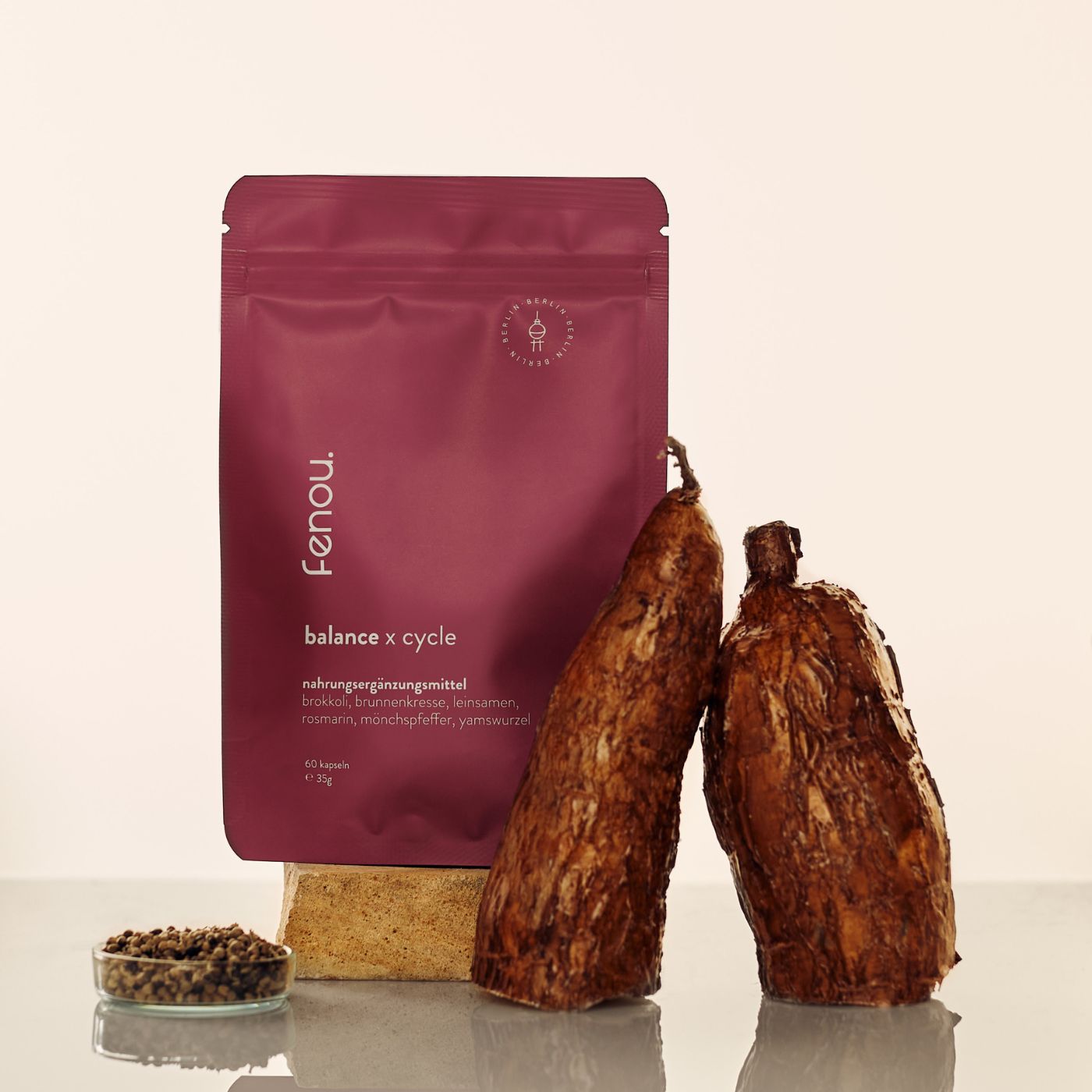
One of our most popular products is balance x cycle. balance contains both chasteberry and watercress as well as yam - of course along with a variety of other plant extracts, minerals, and vitamins.
Our product duo rise&shine x menopause is particularly popular. rise&shine consists of natural, vegan creams with valuable extracts, fragrant essential oils, and nourishing plant oils. Among others, Chinese angelica, red clover, and rose geranium (rise x menopause) and yam and ashwagandha (shine x menopause).
Be sure to convince yourself of the quality of our products. We love the power of medicinal plants and we pass that on to you!

Who is writing this?
Our author Melanie Dell’Oro is a nutritional scientist and has researched naturopathy at Charité for many years. Out of love for phytotherapy, she completed further training as a herbal educator and rounded it off as a certified expert in holistic women's health.